
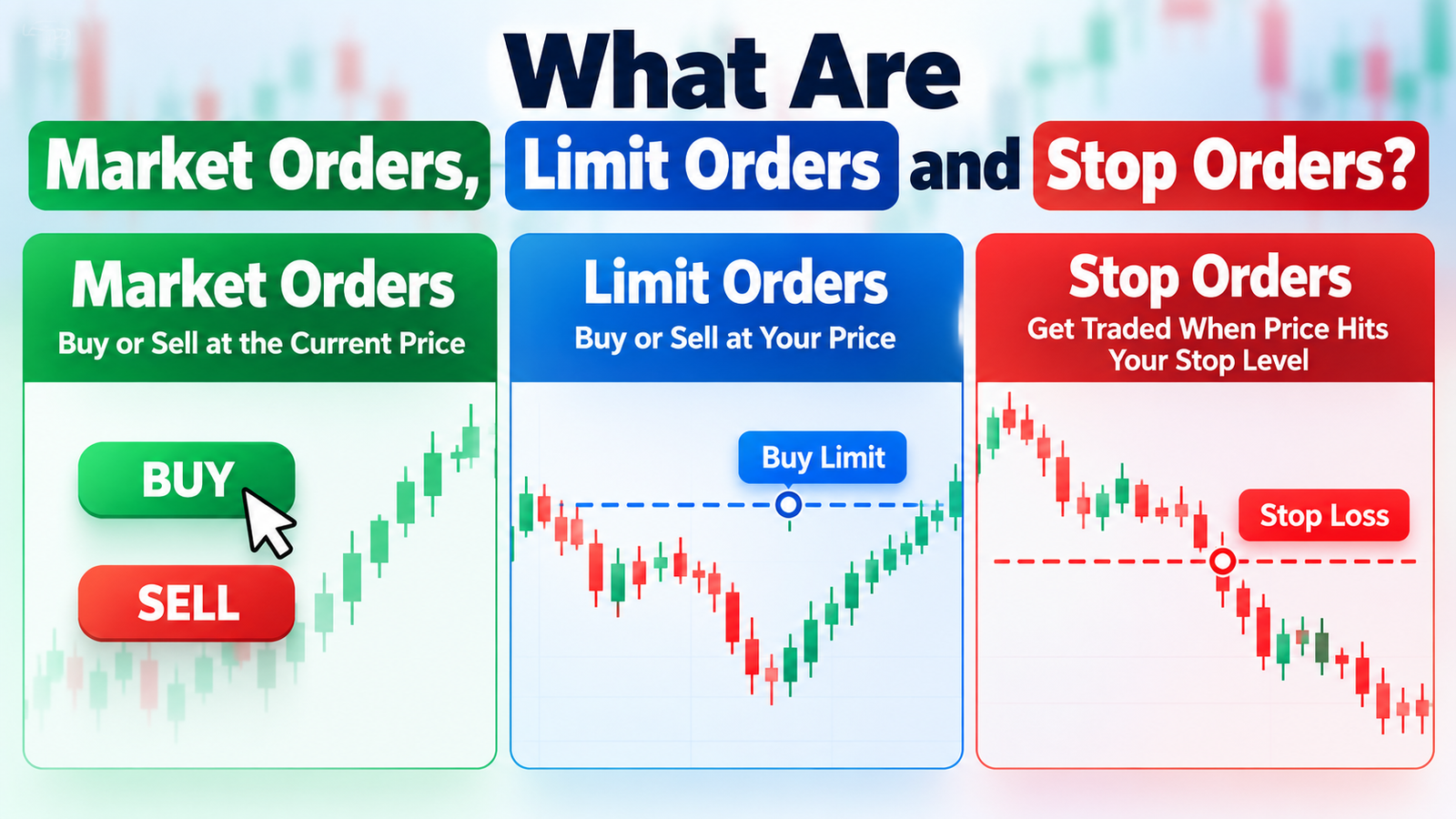
What Are Market Orders, Limit Orders and Stop Orders?
Understanding the different order types in trading is just as important as understanding the market itself. You now know how the stock market works behind the scenes. But knowing the theory isn’t enough — you also need to know exactly how to place a trade correctly. This is where order types come in, and getting this wrong is one of the most common beginner mistakes.
Table of Contents
- Why Order Types Matter
- Market Order — Explained
- Limit Order — Explained
- Stop Order (Stop Loss) — Explained
- Comparing the Three Order Types
- Common Beginner Mistakes With Orders
- Which Order Should You Use, and When?
- Frequently Asked Questions
1. Why Order Types Matter

When you place a trade, you’re not just clicking “buy” or “sell” — you’re choosing how that order gets executed. Choosing the wrong order type can mean paying a worse price than expected, missing a trade entirely, or failing to exit a losing position in time. This single lesson can save you real money from day one.
There are three order types every beginner must understand: Market Orders, Limit Orders, and Stop Orders.
2. Market Order — Explained

A market order tells your broker: “Buy or sell this immediately, at the best available current price.”
You don’t specify a price — you’re prioritizing speed of execution over price precision. This is the fastest way to enter or exit a position, and it almost always gets filled instantly during normal trading hours, since you’re accepting whatever price the market is currently offering.
Example: A stock is trading at ₹300 (bid) / ₹300.50 (ask). If you place a market buy order, it typically executes near ₹300.50 immediately.
Best used when: You want to enter or exit a highly liquid stock quickly and are comfortable with small price variation (called “slippage”).
3. Limit Order — Explained

A limit order tells your broker: “Only buy or sell this at a specific price, or better — never worse.”
Here, you’re prioritizing price control over speed. Your order will only execute if the market reaches your specified price; otherwise, it simply waits in the order book.
Example: A stock is trading at ₹300. You believe ₹295 is a better entry point, so you place a limit buy order at ₹295. Your order only executes if the price actually drops to ₹295 or lower — if it never does, your order simply doesn’t get filled.
Best used when: You have a specific price target in mind and are willing to wait, rather than accept whatever the current market price happens to be.
4. Stop Order (Stop Loss) — Explained

A stop order — most commonly used as a stop loss — tells your broker: “If the price reaches this level, automatically sell (or buy) to limit my loss.”
This is arguably the single most important order type for risk management, and one we’ll return to repeatedly throughout this entire education series. A stop loss doesn’t execute immediately like a limit order; it sits inactive until the price actually reaches your specified trigger level, at which point it activates.
Example: You buy a stock at ₹300 and set a stop loss at ₹290. If the price falls to ₹290, your stop order triggers, and your position is sold automatically — limiting your loss to roughly ₹10 per share, instead of watching it fall further.
Pro Tip: Never enter a trade without deciding your stop loss level first. If you can’t identify where you’d exit a losing trade before entering it, you’re not ready to place that trade yet.
5. Comparing the Three Order Types
| Market Order | Limit Order | Stop Order | |
|---|---|---|---|
| Priority | Speed of execution | Specific price | Risk protection |
| Price Control | None — takes current price | Full — executes at your price or better | Triggers at your chosen level |
| Guaranteed Fill? | Usually yes, instantly | No — only if price is reached | Only if trigger price is reached |
| Main Use | Quick entry/exit | Planned entry at a target price | Limiting losses automatically |
6. Common Beginner Mistakes With Orders

- Using only market orders for everything — this can lead to poor entry prices in volatile, fast-moving stocks
- Never using a stop loss — one of the fastest ways beginners suffer large, avoidable losses
- Setting a limit order price too far from the current price — the order may never get filled, causing missed opportunities
- Forgetting an open limit order exists — leaving unwanted orders active in the market without tracking them
7. Which Order Should You Use, and When?
As a general starting guideline for beginners:
- Use a limit order to enter a trade at your desired price, rather than chasing the current market price
- Always place a stop loss immediately after entering any trade, without exception
- Reserve market orders for situations where speed genuinely matters more than a few rupees of price difference, such as exiting a fast-moving position urgently
This isn’t a rigid rule for every situation, but as a beginner still building discipline, defaulting to controlled orders (limit + stop loss) over impulsive market orders will protect you far more often than it costs you.
8. Frequently Asked Questions
Is a market order or limit order better for beginners?
Limit orders generally give beginners more control and help avoid poor entry prices, especially in volatile stocks. Market orders are better reserved for situations demanding speed.
Does a stop loss guarantee I won’t lose more than planned?
In normal market conditions, yes, it activates at your trigger price. However, in extremely fast or gapping markets, execution can occur at a slightly different price than your exact trigger — this is called slippage.
Can I change or cancel a limit order after placing it?
Yes, as long as it hasn’t been executed yet, you can modify or cancel a pending limit order through your broker’s platform.
What happens if I never set a stop loss?
Without a stop loss, a losing position can continue falling indefinitely with no automatic exit, potentially resulting in much larger losses than a disciplined trader would accept.
What should I learn next?
You’ve now completed all the essential Trading Basics! It’s time to move into our next category — learning to actually read a trading chart, starting with candlesticks and timeframes.
Read “What Is a Trading Chart?” to begin the Chart Reading & Technical Analysis category.
This article is for educational purposes only and does not constitute investment or trading advice. Please read our full Disclaimer before making any trading decisions.