
What Is Trading? A Complete Beginner’s Guide
Every trader you see today — the one confidently reading charts, placing orders, and talking about “support and resistance” — once knew absolutely nothing about trading. Not one single term. If you’re starting from zero right now, feeling a little lost, you are exactly where every successful trader once stood.
This is the very first step of your MorningStocks learning journey. By the end of this post, you will clearly understand what trading actually is, how it works in India, and why it’s different from simply “investing” or “gambling.” More importantly, you’ll know exactly what to learn next — and why.
Table of Contents
- What Is Trading?
- How Does Trading Actually Work?
- Trading vs Investing: What’s the Difference?
- The Different Types of Trading
- Why Do People Lose Money in Trading?
- What You Need to Start Trading
- Your Next Step
- Frequently Asked Questions
1. What Is Trading?
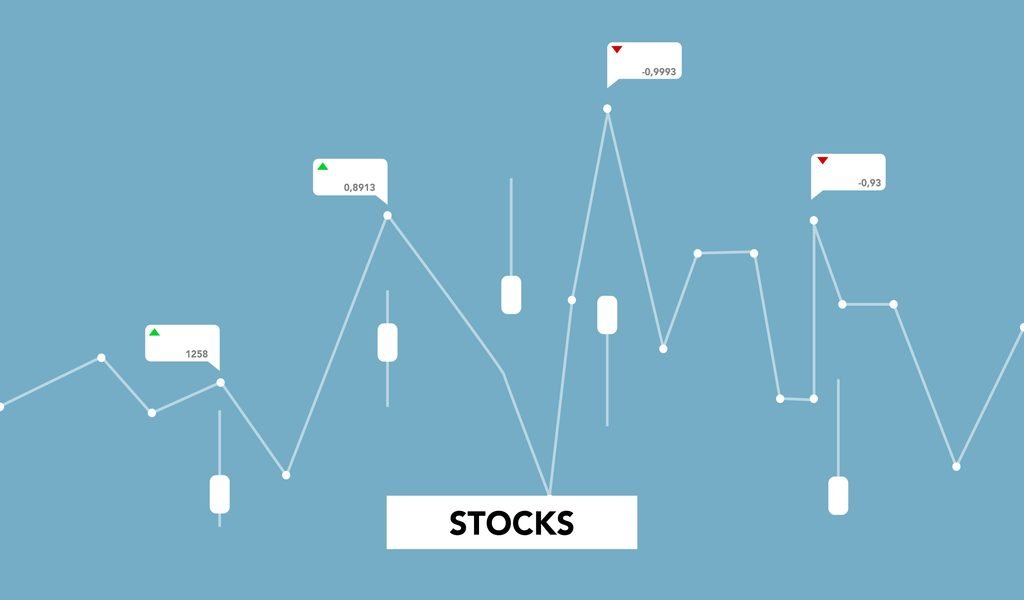
In the simplest terms, trading means buying and selling financial instruments — like stocks, currencies, or commodities — with the goal of making a profit from price changes over a relatively short period of time.
Think of it like this: imagine you buy a cricket bat for ₹500 because you believe a big match is coming up and demand will push its price to ₹600. You sell it at ₹600 and pocket the ₹100 difference. That’s the core idea of trading — buying something at one price and selling it at a better price, based on your understanding of how its value will move.
In the stock market, instead of cricket bats, traders buy and sell shares of companies, derivatives (futures & options), currencies, or commodities like gold and crude oil.
2. How Does Trading Actually Work?
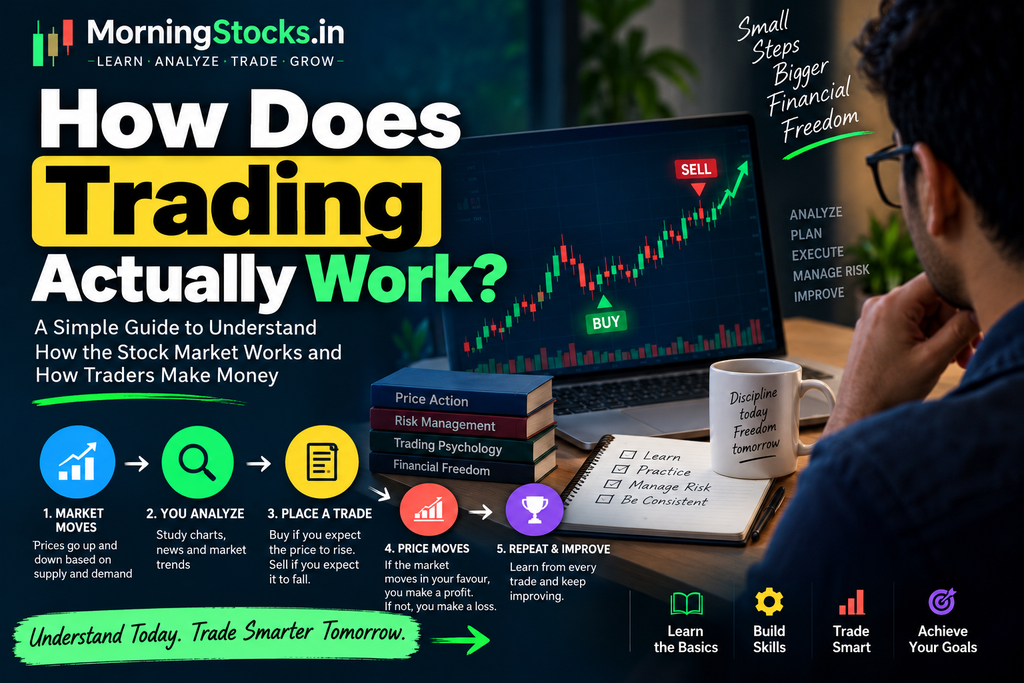
When you place a trade, you’re not directly handing money to a company. You’re participating in a marketplace — in India, this is mainly the NSE (National Stock Exchange) and BSE (Bombay Stock Exchange) — where millions of buyers and sellers meet, and prices move up and down based on demand and supply.
Here’s a simple breakdown of what happens when you trade:
- You open a trading account and a Demat account with a broker.
- You research or analyze a stock (this is where chart reading and price action, which we’ll cover in later posts, come in).
- You place a buy order at a certain price.
- If the price moves in your favor, you place a sell order to book profit.
- If it moves against you, a good trader exits with a small, planned loss (this is called a stop loss — more on that soon).
This cycle — buy, monitor, exit — happens within minutes, days, or weeks, depending on the type of trading.
3. Trading vs Investing: What’s the Difference?
Beginners often confuse these two, so let’s make it crystal clear.
| Trading | Investing | |
|---|---|---|
| Time Horizon | Days to weeks (sometimes minutes) | Years |
| Goal | Profit from price movement | Wealth building over time |
| Involvement | Active, requires daily attention | Passive, occasional review |
| Risk Style | Higher risk, faster results | Lower risk, slower growth |
A trader might buy and sell the same stock three times in a week. An investor might buy a stock and hold it for ten years, regardless of short-term price swings. Neither approach is “better” — they serve different goals. MorningStocks focuses on trading, so from this point on, our journey will be built entirely around that skill.
4. The Different Types of Trading
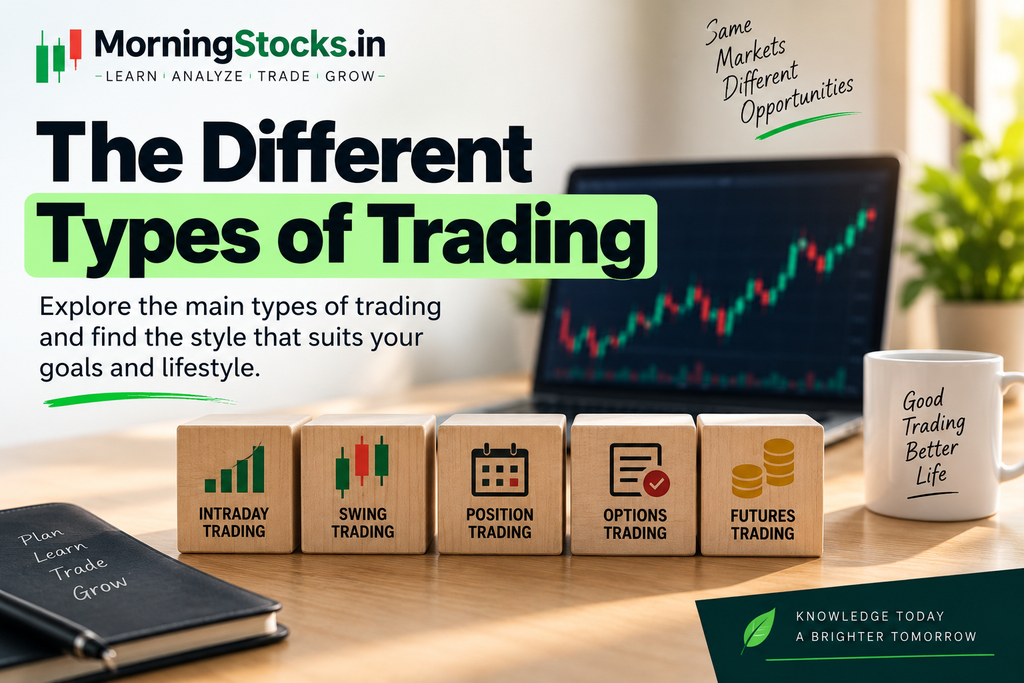
Before we go deeper in future posts, it helps to know that trading isn’t just one single style. The three most common types are:
- Intraday Trading — Buying and selling on the same day, before markets close.
- Swing Trading — Holding a position for a few days to a few weeks to capture a “swing” in price.
- Delivery Trading — Buying shares and holding them for a longer period, taking actual delivery into your Demat account.
We’ll explore each of these in detail in the next two posts of this series, so you can decide which style fits your personality and schedule.
5. Why Do People Lose Money in Trading?

Let’s be honest with you, because that’s what MorningStocks is built on — honesty, not hype. SEBI (Securities and Exchange Board of India) has published data showing that the vast majority of individual traders, especially in the futures & options segment, end up losing money.
This isn’t because trading itself is impossible to succeed at. It’s because most beginners jump straight into buying and selling without understanding the basics — things like reading a chart, managing risk, or controlling their emotions. That’s exactly the gap MorningStocks exists to close, one structured lesson at a time.
Pro Tip: Before you place your very first trade, write down one sentence: “I am risking ₹___ and I am okay if I lose it while learning.” If you can’t complete that sentence honestly, you’re not ready to trade with real money yet.
6. What You Need to Start Trading

At a basic level, you’ll need:
- A Trading Account — to place buy and sell orders
- A Demat Account — to hold your shares electronically
- A Broker — the platform connecting you to the stock exchange
- Basic understanding of market orders, limit orders, and stop orders
- A small amount of starting capital you are fully prepared to risk while learning
Do not start trading with money you cannot afford to lose while you’re still learning. This single piece of advice will save you more than any strategy will.
Key Takeaways: Trading means buying and selling for profit from price movement • It’s different from investing, which is long-term • It requires a trading account plus a Demat account • Most beginners fail due to lack of structured learning, not lack of intelligence.
7. Your Next Step
You now understand what trading is, how it works, and why most beginners struggle. But this is just the entry point. To actually trade with confidence, you need to understand how the stock market itself works behind the scenes — who the participants are, how NSE and BSE function, and what actually moves prices. That’s exactly what we cover in our next lesson.
8. Frequently Asked Questions
Is trading the same as gambling?
No. Gambling relies purely on chance. Trading relies on analyzing price patterns, market data, and managing risk systematically. The outcome isn’t guaranteed, but skilled trading is based on probability and strategy, not luck alone.
How much money do I need to start trading?
There’s no fixed minimum, but it’s wise to start small — an amount you’re fully comfortable risking while you’re still learning, since losses are common in the early stages.
Can I lose more money than I invest in trading?
In simple stock trading (buying shares), your maximum loss is what you invested. However, in derivatives like futures and certain options strategies, losses can exceed your initial investment — which is why risk management is essential.
Do I need a certification to start trading in India?
No certification is legally required to trade using your own money. However, proper education — like the structured lessons on MorningStocks — dramatically improves your chances of trading responsibly and successfully.
What’s the very first thing I should learn after this post?
Understanding how the stock market itself works — NSE, BSE, market participants, and trading sessions. That’s covered in our next post in the Trading Basics series.
Read “How Does the Stock Market Work?” to understand what happens behind every trade you place.
This article is for educational purposes only and does not constitute investment or trading advice. Trading in financial markets carries risk. Please read our full Disclaimer before making any trading decisions.