
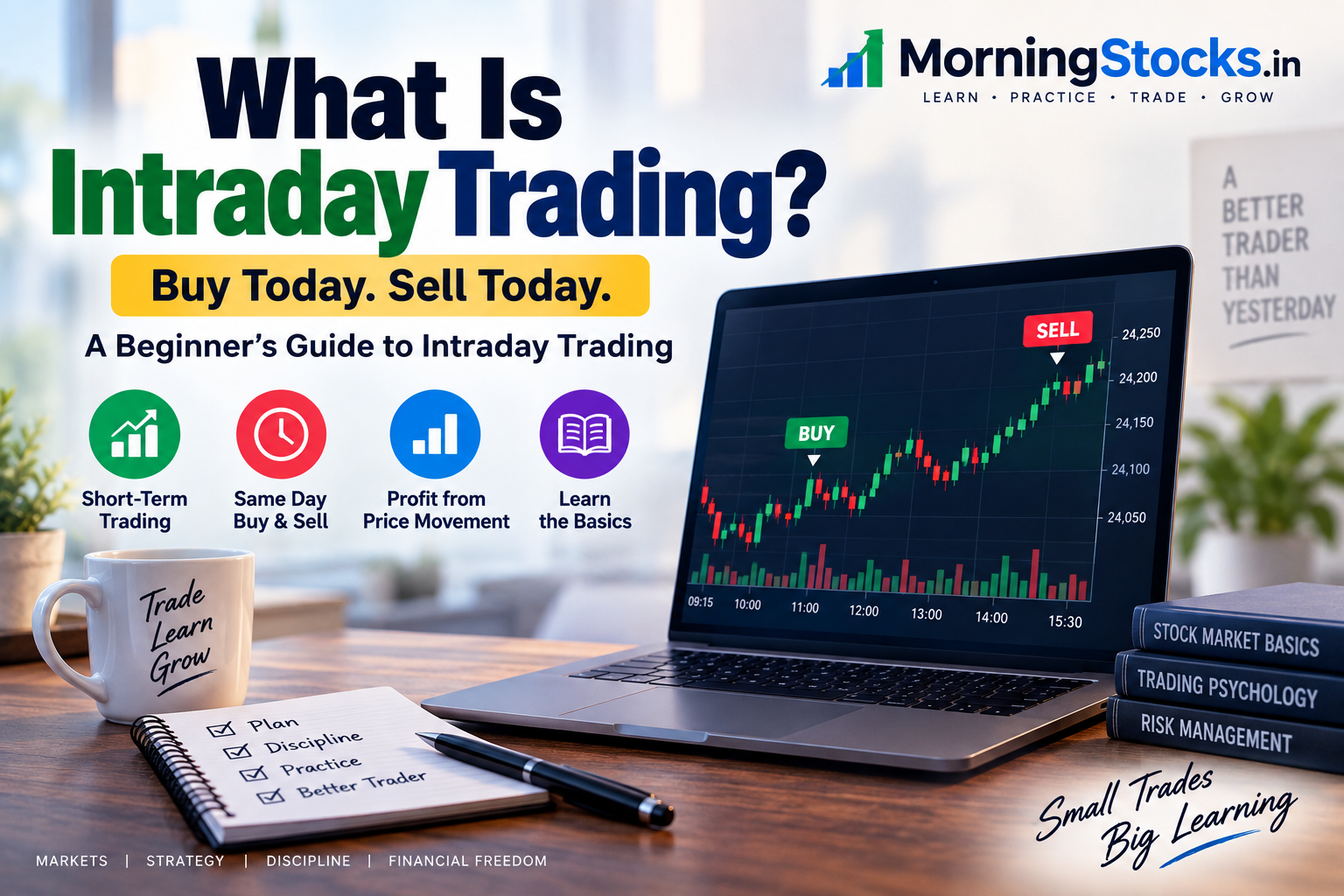
What Is Intraday Trading?
By now you know what trading is and how it’s different from investing. It’s time to look at the fastest-paced style of trading that exists — the one most beginners hear about first: Intraday Trading.
Table of Contents
- What Is Intraday Trading?
- How Intraday Trading Works
- Intraday vs Delivery Trading
- Why Intraday Trading Attracts Beginners
- The Real Risks of Intraday Trading
- Basic Rules Every Intraday Trader Must Follow
- Is Intraday Trading Right for You?
- Frequently Asked Questions
1. What Is Intraday Trading?

Intraday trading means buying and selling a stock (or any instrument) on the same trading day — before the market closes. You never carry the position overnight. If you buy in the morning, you must sell by the end of that trading session, regardless of profit or loss.
The word “intraday” literally means “within the day” — and that’s exactly the boundary you’re working inside.
2. How Intraday Trading Works

Here’s a simple example: Suppose you buy 100 shares of a company at ₹200 in the morning because you believe the price will rise during the day. By 2 PM, the price rises to ₹204. You sell all 100 shares, making a profit of ₹400 (before brokerage and taxes).
If instead the price fell to ₹197, and you didn’t exit in time, your broker’s system would typically auto-square-off your position near market close — meaning it gets sold automatically, whether you’re ready or not. This is one of the most important things beginners must understand: in intraday trading, the clock is always working against an open position.
Most brokers also offer leverage (margin) for intraday trades, letting you trade with more capital than you actually have. This amplifies both potential profits and potential losses — which is why intraday trading is considered higher risk than delivery-based trading.
3. Intraday vs Delivery Trading
| Intraday Trading | Delivery Trading | |
|---|---|---|
| Holding Period | Same day only | Days, weeks, or longer |
| Ownership | Never actually takes share delivery | Shares are credited to your Demat account |
| Leverage | Usually offered by brokers | Usually not offered (full payment required) |
| Overnight Risk | None (no overnight holding) | Present (price can gap up/down next day) |
| Suitable For | Active traders monitoring the market closely | Traders/investors comfortable holding positions |
4. Why Intraday Trading Attracts Beginners

Intraday trading is often the first thing new traders try, for a few understandable reasons:
- It feels exciting — profits (or losses) show up within hours, not weeks
- Leverage makes it feel like you can make bigger profits with smaller capital
- Financial YouTube and social media are full of intraday “success” screenshots
This excitement is exactly why intraday trading is also where most beginners lose money fastest. Speed cuts both ways — quick profits and quick losses look identical on a chart until it’s too late.
5. The Real Risks of Intraday Trading

Let’s stay honest, as always. According to SEBI’s own study on individual investor behavior in the futures & options and intraday segments, a large majority of retail traders lose money over time — and losses tend to increase with trading frequency.
The core risks specific to intraday trading are:
- Leverage risk — losses can be magnified quickly beyond your original capital
- Time pressure — decisions must be made fast, often under emotional stress
- Auto square-off risk — your position may be closed automatically at an unfavorable price if you don’t act in time
- Overtrading — the temptation to keep entering trades throughout the day to “make up” for a loss
Pro Tip: Before your first intraday trade, decide your maximum loss for the entire day — not just per trade. If you hit that number, stop trading for the day, no matter what. This single rule prevents more damage than any strategy.
6. Basic Rules Every Intraday Trader Must Follow

- Always use a stop loss on every single trade — no exceptions
- Never trade with money you can’t afford to lose while learning
- Avoid using maximum leverage as a beginner, even if your broker offers it
- Track every trade in a simple journal (we’ll build this skill fully in our Trading Practice & Journaling category)
- Set a daily loss limit and respect it strictly
7. Is Intraday Trading Right for You?

Intraday trading suits people who can genuinely dedicate active attention during market hours (9:15 AM to 3:30 PM IST) and who can make quick decisions without panicking. If you have a full-time job that keeps you away from your screen during market hours, intraday trading will be extremely difficult to do well — and this is worth being honest with yourself about, early.
If active, minute-to-minute trading doesn’t suit your schedule or temperament, that’s completely fine — Swing Trading, which we cover next, offers a slower-paced alternative within the same short-term trading world.
8. Frequently Asked Questions
Can I lose more money than I invested in intraday trading?
Yes, if you use leverage. Because intraday trades often use borrowed margin from your broker, losses can exceed your original capital in volatile situations. This is why strict stop losses are essential.
What happens if I forget to exit my intraday position?
Most brokers automatically square off (sell) intraday positions shortly before market close, often at a price you didn’t choose. Relying on this “safety net” is risky — always exit on your own terms.
Do I need a lot of money to start intraday trading?
No, but you do need enough to absorb losses while learning without financial stress. Starting with a small, dedicated amount is safer than starting big.
Is intraday trading suitable for a complete beginner?
It’s possible, but risky, without first understanding chart reading, price action, and risk management — all of which we cover in the categories ahead. Rushing into intraday trading before learning these basics is one of the most common beginner mistakes.
What should I learn next?
Now that you understand the fastest-paced trading style, it’s time to look at its slower, less time-intensive cousin: Swing Trading.
Read “What Is Swing Trading?” to learn a trading style that doesn’t require watching the screen all day.
This article is for educational purposes only and does not constitute investment or trading advice. Intraday trading carries a high level of risk, including the possibility of losing more than your invested capital. Please read our full Disclaimer before making any trading decisions.