
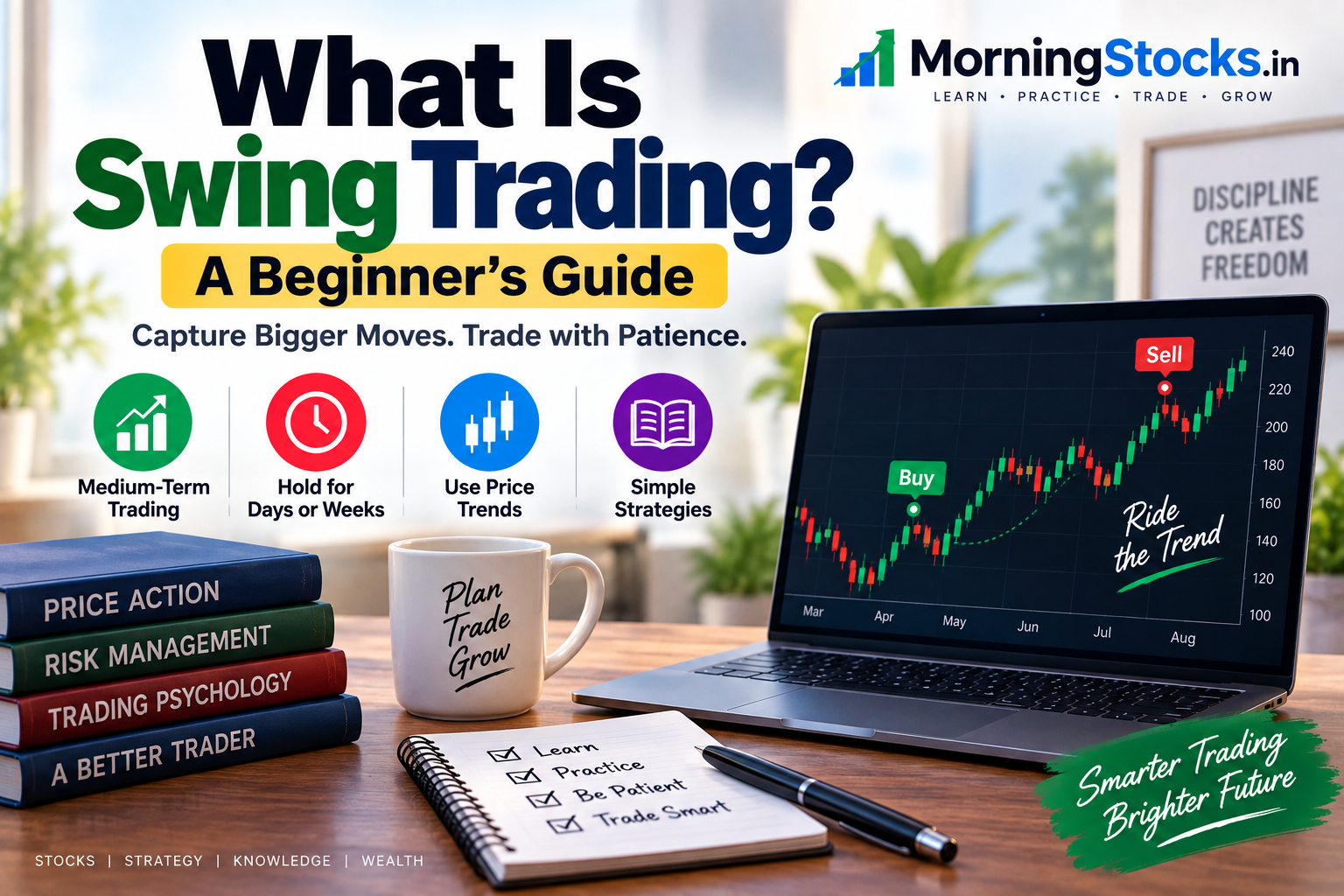
What Is Swing Trading?
You’ve now learned about intraday trading — the fastest-paced trading style, where every position must close the same day. But what if you can’t sit in front of a screen all day? That’s exactly where Swing Trading comes in.
Table of Contents
- What Is Swing Trading?
- How Swing Trading Works
- Swing Trading vs Intraday Trading
- Why Swing Trading Suits Working Professionals
- Risks in Swing Trading
- Basic Rules for Swing Traders
- Which Trading Style Fits You?
- Frequently Asked Questions
1. What Is Swing Trading?

Swing trading means holding a position for more than one day — typically a few days to a few weeks — to capture a “swing” or short-term price movement, without needing to watch the market every single minute.
Unlike intraday trading, where you must exit before the market closes, a swing trader is comfortable carrying a position overnight, and even over a weekend, based on the belief that a stock’s price will continue moving in a certain direction over the coming days.
2. How Swing Trading Works

Suppose you notice a stock forming a strong pattern on its daily chart that suggests it may rise over the next one to two weeks. You buy the stock on Monday at ₹500. Instead of watching every price tick, you check the chart once or twice a day. By the following Thursday, the price reaches ₹540, matching your target — you exit and book your profit.
The key difference from intraday trading: you’re not fighting the clock within a single day. You’re giving the trade room to develop over several sessions, based on the broader chart pattern rather than minute-by-minute price ticks.
Swing traders rely heavily on the chart reading and price action skills we’ll build in our next category — daily and weekly charts, support and resistance zones, and trend identification all become far more important here than in intraday trading.
3. Swing Trading vs Intraday Trading
| Swing Trading | Intraday Trading | |
|---|---|---|
| Holding Period | A few days to a few weeks | Same day only |
| Screen Time Needed | Low — a few checks per day | High — constant monitoring |
| Overnight Risk | Present (price can gap on news) | None |
| Leverage Usage | Lower, often none | Frequently used |
| Best Suited For | Working professionals, part-time traders | Full-time, active traders |
4. Why Swing Trading Suits Working Professionals

If you have a full-time job, college, or other daily commitments that keep you away from your screen during market hours, intraday trading is genuinely difficult to do well. Swing trading solves this problem — you can analyze charts in the evening, place your orders, and check progress once or twice during the day without needing to watch every tick.
This makes it one of the most popular trading styles among people who want to trade seriously without quitting their day job.
Pro Tip: Set your stop loss and target price at the same time you enter a swing trade — not later. This removes the temptation to “hope” a losing trade will recover once you’re away from your screen.
5. Risks in Swing Trading

Swing trading isn’t risk-free simply because it’s slower-paced. The biggest risk is overnight and weekend gap risk — a company’s price can open sharply higher or lower the next trading day due to news, earnings announcements, or global market events that happened while markets were closed. Since you’re not watching the screen constantly, you can’t react to this the moment it happens.
Other common risks include:
- Holding a position too long out of hope rather than a clear plan
- Ignoring your predetermined stop loss when the trade goes against you
- Getting influenced by news or social media instead of your own chart analysis
6. Basic Rules for Swing Traders

- Always define your stop loss and target before entering the trade
- Avoid holding a position through a major company announcement or earnings date unless it’s part of your specific strategy
- Review your open positions daily, even if briefly
- Don’t over-commit capital to a single swing trade — spread risk across positions
- Keep a trading journal to track what worked and what didn’t (covered fully in our Trading Practice & Journaling category)
7. Which Trading Style Fits You?

By now you’ve seen two very different trading styles. Ask yourself honestly:
- Can I actively watch the market for several hours a day? → Intraday may suit you
- Do I have limited time but can check charts once or twice daily? → Swing trading may suit you
- Am I comfortable holding a position overnight, accepting some gap risk? → Swing trading requires this comfort
There’s no wrong answer here — only the answer that matches your real schedule and temperament, not the one that sounds more exciting.
8. Frequently Asked Questions
Is swing trading safer than intraday trading?
Swing trading avoids the extreme time pressure of intraday trading, but it introduces overnight and weekend gap risk that intraday trading doesn’t have. Neither style is inherently “safer” — each carries a different type of risk.
How much time does swing trading require daily?
Typically 30 minutes to an hour for chart review and order management, making it far more compatible with a full-time job than intraday trading.
Can I use leverage in swing trading?
Most brokers offer little to no leverage for positions held overnight, since delivery-based swing trades usually require full payment upfront, unlike many intraday trades.
What should I learn to get better at swing trading?
Chart reading, candlestick patterns, and price action — all covered in detail in our next category, Chart Reading & Technical Analysis. This is the foundation every swing trader needs.
What should I learn next?
Now that you understand the two most common short-term trading styles, it’s time to zoom out and understand how the stock market itself actually works — the exchanges, participants, and mechanics behind every trade.
Read “How Does the Stock Market Work?” to understand what happens behind every trade you place.
This article is for educational purposes only and does not constitute investment or trading advice. Swing trading carries risk, including overnight and weekend price gaps. Please read our full Disclaimer before making any trading decisions.